
Insurance Resources
Insurance for Contractors 101: Building a Safety Net for Your Business
Learn insurance for contractors essentials: coverage types, costs, compliance, and tips to protect your contracting business today.

Why Every Contractor Needs a Financial Safety Net
Insurance for contractors protects your business from costly lawsuits, property damage claims, and workplace injuries that could otherwise bankrupt your operation. Here’s what contractors typically need:
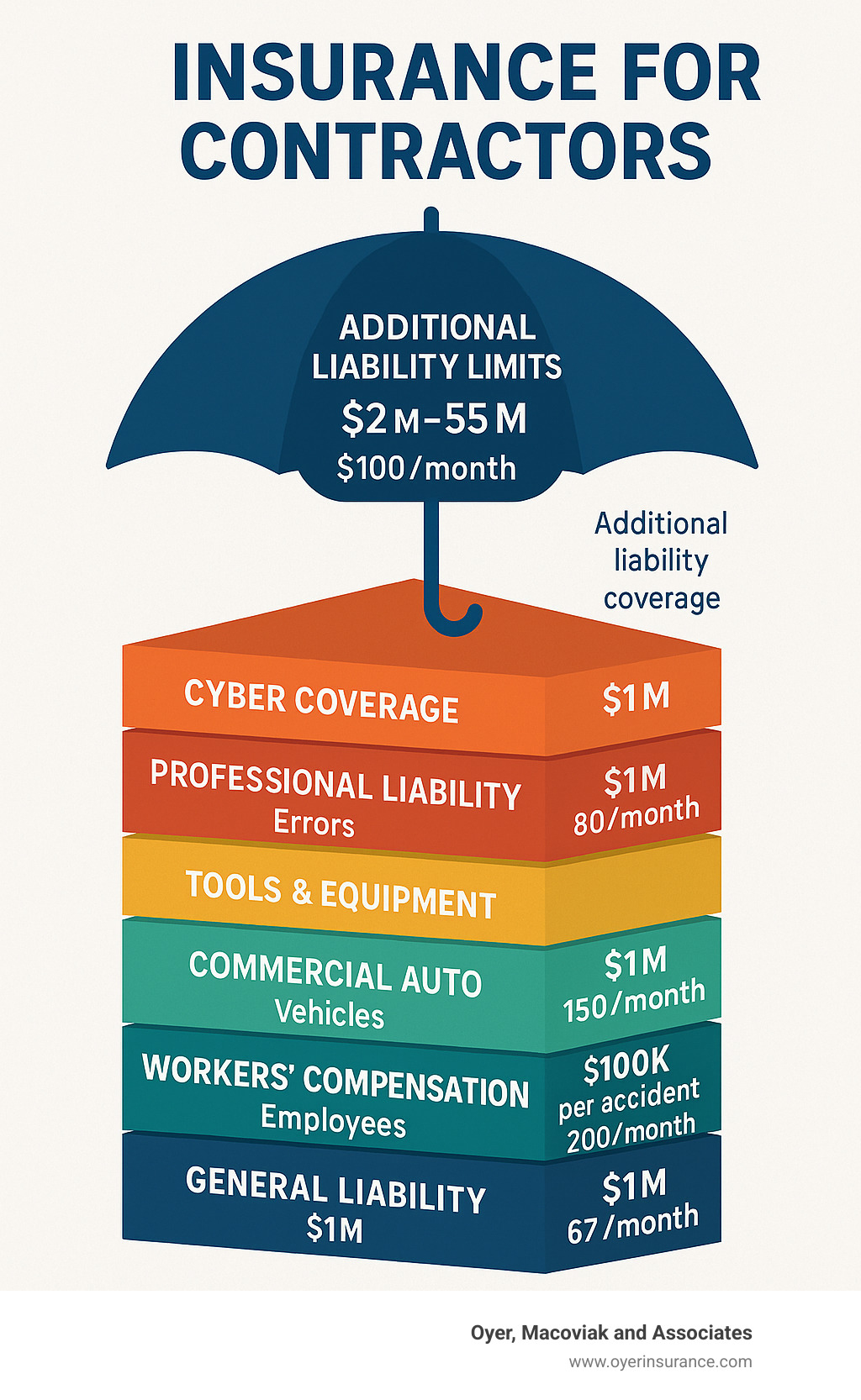
Essential Coverage Types:
- General Liability – Covers third-party injuries and property damage ($67/month average)
- Workers’ Compensation – Required in most states for employees
- Commercial Auto – Protects work vehicles and equipment transport
- Tools & Equipment – Only 22% of stolen equipment is recovered
- Professional Liability – Covers errors in your work
Legal Requirements:
- Most states require general liability for contractor licensing
- Workers’ comp mandatory for businesses with employees (except Texas)
- Client contracts often demand proof of insurance before work begins
Whether you’re a handyman fixing leaky faucets or a general contractor building custom homes, the risks are real. A client could trip over your toolbox and break a leg. Your employee might fall off a ladder. A simple wiring mistake could cause thousands in fire damage.

Ready for a Quote?
Since 1953, Oyer, Macoviak and Associates has helped clients compare insurance options while our independent agency does the shopping work. Tell us what you need once, and we can help review options from more than 30 rated insurance companies.
or Call (561) 732-9305
The construction industry sees 2.4 million workers treated for work-related injuries annually, and fire damage claims average $35,000 per incident. With 40% of small businesses experiencing a claim within 10 years, proper coverage isn’t optional–it’s survival.
I’m Rob Macoviak, and I’ve been helping contractors protect their businesses since taking over our family insurance office in 2006. Our team has grown from two employees to one of Palm Beach County’s largest insurance offices, specializing in insurance for contractors who need personalized coverage that fits their unique risks and budgets.

Contractor Insurance Basics
Picture this: You’re installing kitchen cabinets when your drill slips and damages the homeowner’s granite countertop. Or maybe a client trips over your toolbox and ends up in the emergency room. These aren’t worst-case scenarios–they’re Tuesday afternoons in the construction world.
Insurance for contractors acts like your financial hard hat, protecting your business when life throws you a curveball. It’s not just about covering accidents either. Many states won’t even issue your contractor’s license without proof of insurance, and good luck landing commercial jobs without it.
The reality is simple: one lawsuit can wipe out years of hard work. But with the right coverage, you can focus on what you do best–building, fixing, and creating–while knowing your business is protected.
What Is Contractor Insurance & Why Is It Important?
Contractor insurance isn’t your typical business policy. It’s specifically designed for the unique headaches that come with construction work. Think jobsite injuries, property damage from your work, and specialized equipment that costs more than most people’s cars.
The big thing to understand is third-party protection. This covers situations where someone else claims you’re responsible for their problems. Say you’re rewiring a house and accidentally damage the neighbor’s fence with your truck. General liability insurance handles the repair costs and any legal drama that follows.
Without coverage, you’re paying these bills yourself. We’ve seen contractors face $50,000+ lawsuits over accidents that seemed minor at first. That’s enough to sink most small businesses overnight.
But here’s the thing–insurance does more than protect your wallet. It protects your reputation too. When potential clients see you carry proper coverage, you instantly look more professional than the guy who “keeps costs low” by skipping insurance. Trust me, that’s not the kind of savings that pays off long-term.
Who Needs It? From Handymen to GCs
Whether you’re a one-person handyman fixing leaky faucets or a general contractor managing million-dollar projects, you need protection. The risks don’t care about the size of your business–they just care about the size of your bank account when something goes wrong.
Independent contractors like electricians, plumbers, HVAC technicians, painters, carpenters, and landscapers often think they’re too small to need insurance. That’s backwards thinking. You’re actually more vulnerable because you don’t have the financial cushion that larger companies might have.
Companies with crews face additional challenges. Residential builders, commercial construction companies, remodeling contractors, and roofing companies need to protect not just against third-party claims, but employee injuries too. Workers’ compensation becomes mandatory in most states once you have employees.
The type of work matters too. Commercial projects typically demand higher coverage limits and additional features like completed operations coverage. This protects you months or even years after you’ve finished a job because sometimes problems don’t show up right away.
Even if you work solo, don’t think you’re off the hook. A single accident can generate medical bills, legal fees, and damage costs that would take years to pay off. We’ve helped plenty of independent contractors who learned this lesson the hard way.
Coverage You Can’t Build Without
Think of contractor insurance like the layers of protection on a construction site–hard hats, safety harnesses, and steel-toed boots all work together to keep you safe. Your insurance for contractors works the same way, with different policies protecting against different risks that could otherwise shut down your business.
More info about Contractor Public Liability Insurance

General Liability: The Foundation of insurance for contractors
General liability insurance is like the concrete foundation of your coverage–everything else builds on top of it. This policy steps in when someone claims you caused their injury or damaged their property, which happens more often than most contractors expect.
Picture this: you’re installing kitchen cabinets when the homeowner’s curious toddler trips over your drill case and breaks his arm. The emergency room visit costs $8,000, but the parents also want compensation for missed work and emotional distress. Without general liability, you’re writing checks that could easily reach $25,000 or more.
Third-party bodily injury coverage handles medical bills when someone gets hurt because of your work. Property damage protection pays when you accidentally break something that isn’t yours–like drilling through a water pipe and flooding a basement. Legal defense costs are included even if the claim turns out to be bogus, which is crucial since attorney fees can mount quickly.
The completed operations component is especially important for contractors. This coverage protects you after you’ve finished a job and left the site. If electrical work you completed six months ago sparks a house fire, completed operations coverage handles the resulting claims. Many contractors don’t realize their liability doesn’t end when they pack up their tools.
At around $67 per month for most small contractors, general liability insurance costs less than your monthly phone bill but protects against claims that could bankrupt your business overnight.
Beyond Basics: Workers’ Comp, Auto, and More
Once you have that liability foundation in place, other coverage types protect specific parts of your operation that general liability doesn’t touch.
Workers’ compensation insurance becomes mandatory the moment you hire your first employee (except in Texas, where it’s optional but highly recommended). This coverage takes care of medical bills and lost wages when employees get injured on the job. With over 2.4 million workers receiving emergency treatment for work-related injuries each year, workers’ comp isn’t just legally required–it’s financially essential.
Your premium depends on your payroll and trade classification. Roofers pay more than interior painters because their injury rates are higher. However, maintaining good safety practices can reduce your experience modifier and cut premiums by up to 30%.
Commercial auto insurance protects work vehicles and equipment transport. Your personal auto policy won’t cover business use, leaving you exposed if an employee causes a fender-bender while driving to a jobsite. Commercial auto also covers tools and materials being transported in your vehicles.
Tools and equipment coverage addresses one of contractors’ biggest fears–theft. With only 22% of stolen construction equipment ever recovered, losing your tools can put you out of business for weeks while you scramble to replace everything. This coverage can be added to your general liability policy or purchased as separate inland marine insurance.
Surety bonds aren’t insurance in the traditional sense, but they’re often required for larger projects. These bonds guarantee you’ll complete the work according to contract specifications. Builders risk insurance protects structures under construction from fire, theft, and weather damage.
Optional Add-Ons That Save the Day
Smart contractors look beyond basic coverage to address risks that didn’t exist when their grandfathers were swinging hammers.
Professional liability insurance covers mistakes in your professional services rather than physical accidents. If you design a deck that collapses because you miscalculated the load requirements, professional liability handles the resulting claims. General liability won’t touch this type of error.
Cyber liability insurance might seem unnecessary for contractors, but think about all the customer information stored on your phone and computer. If hackers steal client data or ransomware locks up your files, cyber coverage pays for recovery costs and legal notifications.
Pollution liability protects against environmental contamination claims. Even something as simple as a fuel spill from your generator could trigger expensive cleanup requirements. Subcontractor default insurance steps in when a subcontractor fails to complete their work, leaving you holding the bag.
Umbrella insurance extends your liability limits beyond standard policies, typically adding $1-5 million in additional coverage. For high-value projects or high-risk work, umbrella coverage provides crucial extra protection at a relatively low cost.
Cost & Compliance: What Affects Your Premium?
When contractors ask me about insurance for contractors costs, I always tell them it’s like pricing a custom kitchen–the final number depends on what you’re building and how you’re building it. Understanding these cost factors helps you make smart decisions about coverage while keeping your budget intact.
Your trade classification has the biggest impact on premiums. Insurance companies know that roofers face more risks than painters, and they price accordingly. A roofer might pay three times more for workers’ compensation than a finish carpenter because injury rates vary dramatically between trades.
Annual payroll drives workers’ compensation costs directly. If you’re paying $490,000 in wages annually, expect higher premiums than someone with a $100,000 payroll. But here’s the thing–this also means you’re growing your business, which is worth celebrating.
Location matters more than you might think. A contractor in downtown Miami pays more than someone working in rural Georgia because construction costs, medical expenses, and legal settlements run higher in urban areas.
Your claims history follows you like your reputation. File multiple claims, and insurers see you as high-risk. Maintain a clean record, and you’ll earn preferred rates. One major claim can affect your premiums for up to five years.
Coverage limits and deductibles work like a see-saw. Choose higher limits for better protection but expect higher premiums. Opt for higher deductibles to lower monthly costs, but make sure you can afford the out-of-pocket expense when claims happen.
The average contractor pays around $67 monthly for general liability, though this varies wildly. A Texas plumbing contractor might pay $12,773 annually on $490,000 in payroll, while a Florida handyman could pay just $800 per year.
| Trade Type | General Liability (Annual) | Workers’ Comp (per $100 payroll) | Commercial Auto (Annual) |
|---|---|---|---|
| Handyman | $800-$1,200 | $2.50-$4.00 | $1,200-$2,000 |
| Electrician | $1,500-$2,500 | $3.00-$5.50 | $1,500-$2,500 |
| Plumber | $1,200-$2,000 | $2.75-$4.25 | $1,400-$2,200 |
| Roofer | $3,000-$5,000 | $8.00-$15.00 | $2,000-$3,500 |
| General Contractor | $2,500-$4,500 | $4.00-$8.00 | $1,800-$3,000 |
Is Contractor Insurance Required by Law or Clients?
The short answer is yes, but it’s complicated. Legal requirements vary by state and trade, creating a patchwork of regulations that can confuse even seasoned contractors.
Most states require general liability insurance for contractor licensing. Workers’ compensation is mandatory for businesses with employees in every state except Texas, where it’s optional but still recommended.
With 2.4 million workers receiving emergency treatment for work-related injuries annually, workers’ comp isn’t just legally required–it’s financially essential.
Client requirements often exceed legal minimums. Commercial clients routinely demand $1 million in general liability per occurrence with $2 million aggregate coverage. They’ll also require additional insured endorsements, waiver of subrogation clauses, and certificates of insurance before you can start work.
Surety bonds add another layer of complexity for public works projects or large commercial jobs. These guarantee your performance and ensure subcontractors and suppliers get paid.
Budget Smart: How to Lower the Price Tag
Smart contractors know how to reduce premiums without sacrificing protection. It’s about being strategic, not cheap.
Safety programs demonstrate your commitment to risk reduction and can significantly lower workers’ compensation premiums. Document your safety training, maintain OSHA compliance, and implement return-to-work programs. Insurers reward contractors who take safety seriously, sometimes reducing premiums by 20% or more.
Higher deductibles offer immediate premium savings but require careful consideration. Choose deductibles you can comfortably afford when claims occur.
Bundle discounts reward contractors who purchase multiple policies from the same carrier. You can save an average of 12% by bundling auto and property coverage, and up to 25% with comprehensive packages.
Annual policy reviews ensure you’re not overpaying for coverage you don’t need or underinsured for current risks. As your business grows and changes, your insurance needs evolve too.
At Oyer, Macoviak and Associates, we’ve been helping contractors steer these decisions since 1953. Our professionals understand that every dollar counts in construction, and we work to find coverage that protects your business without breaking your budget.
Managing Proof, Claims & Subcontractors
The paperwork side of insurance for contractors might not be as exciting as swinging a hammer, but it’s just as crucial for protecting your business. Whether you’re providing proof of coverage to clients, filing a claim, or managing subcontractor risks, understanding these processes keeps your projects moving smoothly.
What Insurance Policies Do Contractors Need?

Certificates & Additional Insureds in insurance for contractors Contracts
Think of Certificates of Insurance (COIs) as your business license to work. These simple documents prove you have coverage, and virtually every commercial client–plus many homeowners–will demand one before you can start work.
Modern insurance companies make getting certificates painless. Most provide 24/7 online access through websites or mobile apps. You can download or email certificates instantly, eliminating delays that used to frustrate contractors and clients alike.
There’s a big difference between being a certificate holder and an additional insured. A certificate holder simply receives proof that you have insurance–they’re listed on the document but aren’t actually covered by your policy. An additional insured gets protection under your liability coverage for claims arising from your work.
Many clients require additional insured status, especially on commercial projects. While this costs extra, it’s often non-negotiable. The client wants your insurance to protect them if something goes wrong with your work.
Waiver of subrogation clauses prevent your insurance company from going after clients for reimbursement, even when the client shares blame for a loss. It’s commonly required in construction contracts and helps maintain good client relationships.
Common Claims & How Insurance Responds
Understanding how insurance for contractors responds to real-world problems shows why coverage is so valuable.
Tool and equipment theft hits contractors hard. When thieves break into your truck or storage facility, they’re stealing your ability to work. With only 22% of stolen equipment ever recovered, inland marine coverage becomes your lifeline, replacing tools quickly so you can get back to earning.
Workplace injuries happen despite your best safety efforts. When an employee falls off a ladder and breaks an arm, workers’ compensation steps in immediately. It covers medical bills, lost wages, and rehabilitation costs without you having to dig into business accounts.
Fire damage claims are particularly scary because they often involve your completed work. The average fire claim costs $35,000, but your completed operations coverage handles both the property damage and legal defense.
Auto accidents involving work vehicles can devastate uninsured contractors. When your employee rear-ends someone while driving to a jobsite, commercial auto coverage protects your business from potentially massive liability claims.
When claims happen, quick action makes all the difference. Report incidents immediately to your insurance carrier, document everything with photos and witness statements, and cooperate fully with investigators.
Working With Subs Without Extra Risk
Subcontractors can make or break your projects–and your insurance claims. Smart general contractors protect themselves by managing sub-related risks before problems arise.
Requiring certificates of insurance from every subcontractor isn’t just good business–it’s essential protection. Before any sub sets foot on your jobsite, verify they carry adequate general liability and workers’ compensation coverage.
Indemnification clauses in your subcontractor agreements require subs to defend and protect you from claims arising from their work. These clauses are only as strong as the sub’s insurance coverage and financial resources.
The CG2294 exclusion in standard general liability policies often excludes coverage for subcontractor work. If an uninsured sub causes damage, your policy might not respond at all. You can remove this exclusion for additional premium.
Subcontractor default insurance offers first-party protection when subs fail to perform or complete their work. This specialized coverage can save your project when a key subcontractor goes out of business mid-job.
Choosing a Provider, Avoiding Mistakes & FAQs
Finding the right insurance partner for your contracting business is like hiring a reliable subcontractor–you want someone who’ll be there when you need them most, not just when you’re signing the check. The cheapest policy often becomes the most expensive when claims get denied or service falls short.
How to Pick the Right Policy & Partner
The insurance world offers two main paths: working with an independent agent or buying directly through online platforms. Independent agents represent multiple carriers, giving you options and personalized service. They understand construction risks and can explain policy details in plain English.
Financial strength matters more than flashy marketing. Stick with carriers rated “A” or better by AM Best–these companies have the resources to pay claims when disaster strikes.
Your coverage should match your specific risks. A residential handyman faces different exposures than a commercial roofer. Make sure your policy addresses your trade’s unique hazards, from tools and equipment coverage for specialty contractors to completed operations for builders.
Service speed can make or break your business. Look for carriers offering 24/7 certificate access through online portals or mobile apps. When a client needs proof of insurance before you can start work Monday morning, waiting until business hours isn’t an option.
Some carriers go beyond basic coverage by offering loss control services–safety training, risk assessments, and consultation that can reduce both your premiums and actual losses.
Policy limits and endorsements deserve careful attention. Standard $1 million limits might seem adequate until you’re working on a $2 million custom home.
Frequently Asked Questions about Insurance for Contractors
- Do independent contractors need workers’ compensation?
Most independent contractors working alone don’t need workers’ comp since they’re not employees. However, some states require coverage regardless of business structure, and certain clients may demand it contractually. The moment you hire your first employee–even part-time help–workers’ comp becomes mandatory in most states.
- What’s the difference between certificate holder and additional insured?
Think of a certificate holder as someone who gets a copy of your report card–they see proof you have insurance for contractors, but they’re not protected by your policy. An additional insured actually gets covered under your policy for liability arising from your work.
Most commercial clients require additional insured status because it provides them much broader protection. If a client gets sued over something related to your work, additional insured coverage helps defend them.
- How fast can I get proof of coverage?
With modern carriers, you can often download certificates instantly through online portals or mobile apps. Many provide 24/7 access, so you can get certificates at midnight if needed. However, adding additional insureds or making policy changes typically requires 24-48 hours.
Insurance for contractors costs vary dramatically based on your trade, location, and coverage needs. While general liability averages $67 monthly for small businesses, high-risk trades like roofing pay significantly more. Workers’ compensation depends on payroll and can range from $0.50 to $15 per $100 of wages.
Bundling policies typically saves money–an average of 12% for combining auto and property coverage, up to 25% for comprehensive packages. And yes, you absolutely need to verify your subcontractors carry insurance.
Conclusion
Think about it this way: you wouldn’t show up to a jobsite without your hard hat and safety boots, so why would you run your contracting business without proper financial protection? Insurance for contractors isn’t just another business expense–it’s the smart investment that keeps your dreams alive when everything goes sideways.
The numbers don’t lie. With 2.4 million workplace injuries happening every year, fire damage claims hitting an average of $35,000, and nearly half of all small businesses dealing with claims within a decade, you’re not gambling on if something will happen. You’re preparing for when it does.
Here’s what I’ve learned after nearly two decades in this business: contractors who treat insurance as an afterthought usually learn its value the hard way. The ones who plan ahead sleep better at night and keep building their businesses while their competitors deal with lawsuits and bankruptcy lawyers.
At Oyer, Macoviak and Associates, we’ve been walking alongside contractors throughout Florida, Georgia, North Carolina, and Tennessee since 1953. That’s seventy years of understanding that a roofer in Jacksonville faces different risks than a plumber in Charlotte, and that your insurance should reflect those differences.
Our professionals work with over 30 “A” rated insurance companies, which means we’re not trying to squeeze your square-peg business into some round-hole policy. Whether you’re a solo handyman just getting your license or you’re running crews on million-dollar commercial projects, we take time to understand what keeps you up at night–then we find coverage that lets you focus on what you do best.
The best part? We explain everything in plain English. No insurance jargon, no fine print surprises, just honest conversations about protecting what you’ve worked so hard to build.
Your contracting business represents more than just income–it’s your independence, your reputation, and your family’s future. Don’t leave it vulnerable to the next lawsuit or workplace accident.
Contact us today for a comprehensive review of your current coverage, or let’s talk about protecting your growing business with the right insurance for contractors solutions. Review your policies every year–what protected you as a startup won’t cut it when you’re landing bigger projects and hiring employees.
Build your success on solid ground. Get the coverage that grows with your ambitions.
More info about Insurance for General Contractors

Robert Macoviak is the President of Oyer, Macoviak and Associates. Oyer, Macoviak and Associates is the oldest independent insurance agency in Boynton Beach and has been in business since 1953. Oyer, Macoviak and Associates are vested members of the community who are committed to doing business face-to-face and being your insurance advocate in times of need.