
Insurance Resources
Do Florida Condos Need Liability Insurance? Here’s the Scoop
Can condos in florida be required to carry liability insurance? Learn the rules, owner mandates, and how to stay compliant in 2024.

Understanding Florida Condo Liability Insurance Requirements
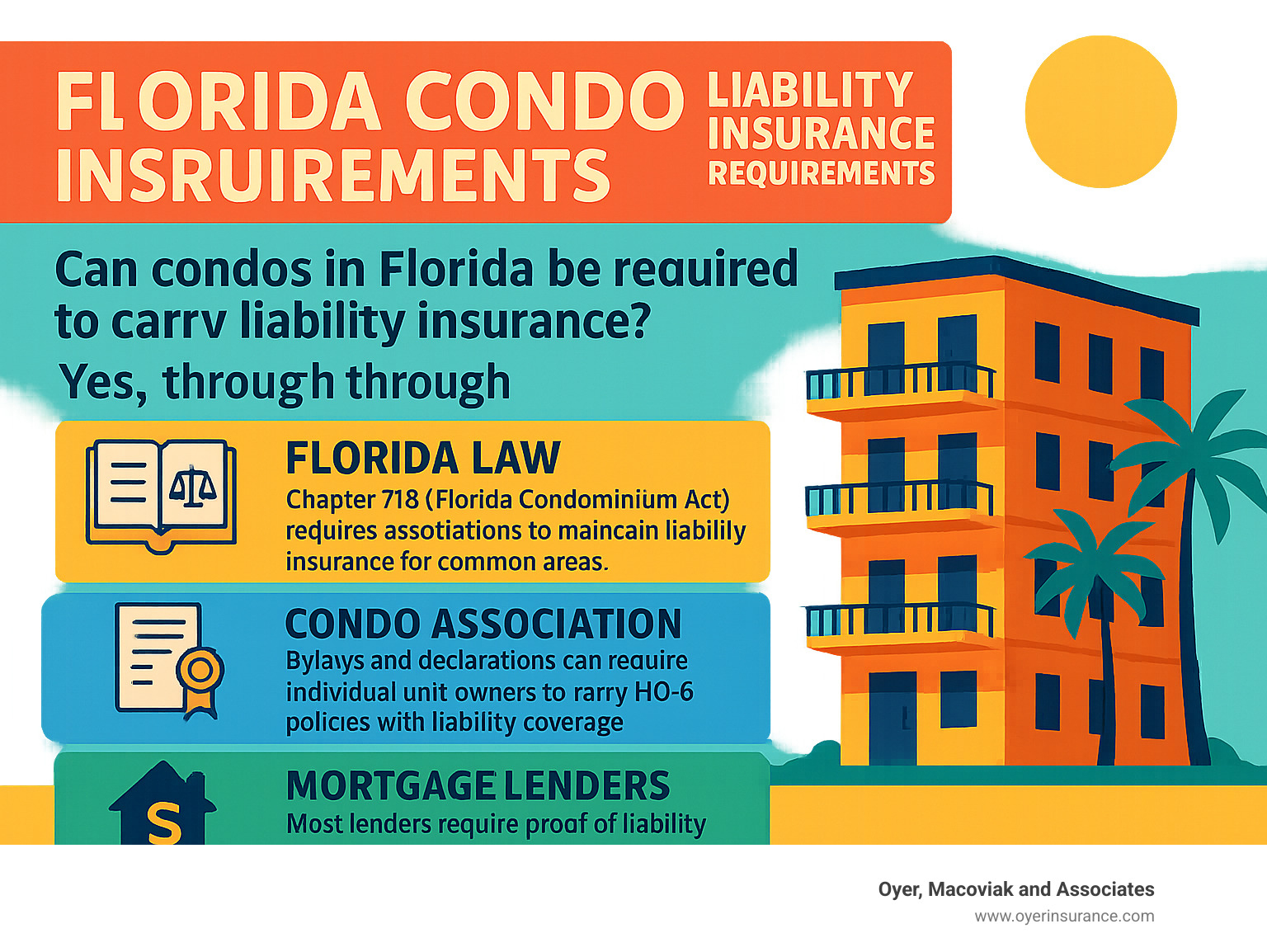
Can condos in Florida be required to carry liability insurance? Yes, they can and often are required to do so through multiple channels:
| Requirement Source | Liability Insurance Mandate |
|---|---|
| Florida Law | Chapter 718 (Florida Condominium Act) requires associations to maintain liability insurance for common areas |
| Condo Association | Bylaws and declarations can require individual unit owners to carry HO-6 policies with liability coverage |
| Mortgage Lenders | Most lenders require proof of liability insurance as a condition of financing |
In a state like Florida—prone to hurricanes, flooding, and other natural disasters—insurance isn’t just necessary; it’s critical. While the Florida Condominium Act mandates that associations carry liability insurance for common areas and shared spaces, the requirements for individual unit owners can vary based on association bylaws and mortgage requirements.
The stakes are high for both associations and unit owners. Without proper liability coverage, a single slip-and-fall accident in a common area could lead to financial disaster for an association, while an incident within a unit could devastate an individual owner’s finances.
Every condominium association in Florida should understand that maintaining adequate liability insurance isn’t just good practice—it’s a legal obligation under state law. For individual unit owners, knowing whether your association requires you to carry your own liability policy is essential to protecting your investment and complying with community rules.

Ready for a Quote?
Since 1953, Oyer, Macoviak and Associates has helped clients compare insurance options while our independent agency does the shopping work. Tell us what you need once, and we can help review options from more than 30 rated insurance companies.
or Call (561) 732-9305
I’m Rob Macoviak, President of Oyer, Macoviak and Associates, and I’ve spent over 17 years helping Florida condo associations and unit owners steer the complex requirements around whether can condos in Florida be required to carry liability insurance through my work at one of Palm Beach County’s leading insurance offices.
Can condos in florida be required to carry liability insurance helpful reading:
- Florida condo insurance requirements
- Florida condo insurance coverage
- condo association insurance florida
Florida Condo Liability Requirements Under Chapter 718
When it comes to protecting your Florida condo community, Chapter 718.111(11) of the Florida Condominium Act doesn’t leave much room for interpretation. This law clearly states that condo associations must maintain adequate insurance to protect the common elements and association property.
Can condos in Florida be required to carry liability insurance? Absolutely. Florida law requires every residential condo association to use its “best efforts” to obtain and maintain liability insurance. This isn’t just a suggestion—it’s a legal mandate.

The “best efforts” standard means associations must make all reasonable attempts to secure appropriate coverage, even when Florida’s insurance market gets tough (which, let’s be honest, happens quite often). This is particularly important in our hurricane-prone state, where liability risks can spike dramatically after storms.
Your association must carry liability insurance covering bodily injury and property damage occurring in common areas—those lobbies, hallways, elevators, pools, and other shared spaces that make condo living so convenient. Board members who neglect this responsibility aren’t just taking risks—they’re potentially breaching their fiduciary duty to the association and its members.
For more detailed information, check out our guides on Florida Condominium Insurance Law and Condominium Insurance – Enough Coverage? or visit the Florida Division of Condominiums, Timeshares and Mobile Homes for official state guidance.
State vs. Association Rule-Making Power
There’s an important dance between state laws and your association’s governing documents:
State statutes set the floor—the minimum requirements all associations must follow. These trump anything in your association documents that might contradict them.
Your declaration of condominium (those hefty “condo docs” you received when purchasing) may contain additional insurance requirements beyond what the state mandates.
Association bylaws often include more detailed insurance provisions, including potential requirements for individual unit owners.
Board resolutions can address specific insurance matters, though they can’t override state law or your declaration.
While Florida law requires associations to carry liability insurance, it doesn’t explicitly mandate individual unit owners to carry their own liability policies. However—and this is important—your association can (and often does) require this through its governing documents.
Typical Coverage Limits for Associations
Most Florida condo associations maintain liability insurance with these typical coverage limits:
$1 million to $2 million per-occurrence limits
$2 million to $4 million aggregate limits per policy period
Larger communities or those with extensive amenities often add umbrella liability policies for extra protection, sometimes reaching $5 million, $10 million, or more.
Don’t forget: Florida law requires an independent insurance appraisal of your property’s replacement cost at least once every 36 months. While this primarily affects property insurance, it indirectly impacts liability considerations by ensuring accurate valuation of those common elements.
For coastal or low-lying communities (which describes many Florida condos), flood insurance considerations often overlap with liability concerns, particularly regarding water-related injuries or damages.
Who Pays the Premiums?
You might wonder who foots the bill for all this protection. The answer: everyone in the community, through:
Your annual budget, which includes liability insurance as a line item
Regular assessments paid by all unit owners
Occasionally, reserve funds when premiums spike unexpectedly
The cost is distributed among all unit owners according to their ownership percentage as defined in your declaration. Owners of larger units generally pay proportionally more.
Regarding deductibles, Florida law requires that decisions about hurricane deductibles must be made at properly noticed board meetings. Many associations choose higher deductibles to keep premiums manageable—but this creates potential assessment risk if a claim occurs.
At Oyer, Macoviak and Associates, we’ve been helping Florida condo associations steer these requirements since 1953. We understand that each community has unique needs, and we’re committed to finding the right balance of protection and affordability for your association.
Can Condos in Florida Be Required to Carry Liability Insurance?
Can condos in Florida be required to carry liability insurance? The short answer is yes – but there’s more to the story than a simple yes or no.
When we talk about condo insurance requirements, we need to look at two sides of the coin: what’s required for the association as a whole, and what’s required for you as an individual unit owner.
For condo associations, there’s no gray area here. Florida law, specifically Chapter 718 of the Florida Statutes, clearly requires all condominium associations to maintain liability insurance covering common areas and shared spaces. This isn’t optional or up for debate – it’s a legal obligation.
For individual unit owners like you, requirements typically come from three places:
First, your condo association’s governing documents. While state law doesn’t directly mandate that you carry liability insurance for your unit, many associations include this requirement in their bylaws or declarations. These rules have real teeth – associations can enforce them through various means.
Second, if you have a mortgage, your lender almost certainly requires liability coverage. This is standard practice for virtually all mortgage companies operating in Florida.
Third, there’s simple practical necessity. Even without formal requirements, going without liability coverage puts your financial future at serious risk.
Most associations that require proof of insurance will ask you to provide documentation annually or when you renew your policy. They’ll typically request to be listed as an “additional interested party” on your policy, which means they’ll be notified if your coverage lapses or is canceled.
Can Associations Compel Unit Owners to Buy Policies?
Yes, your condo association absolutely can require you to purchase your own insurance policy, including liability coverage. This authority comes directly from their governing documents – usually the declaration of condominium and bylaws.
When associations mandate individual insurance, they’re typically looking for HO-6 policies (specifically designed for condo owners). These policies bundle several important coverages together:
Personal property protection for your belongings, dwelling coverage for your unit’s interior finishes, personal liability coverage (usually starting at $100,000), and loss assessment coverage (Florida law requires a minimum of $2,000).
If you ignore these requirements, associations have several ways to enforce compliance. They might issue fines, place a lien on your unit, or in serious cases, even begin foreclosure proceedings. Some associations will purchase “force-placed” insurance on your behalf and then bill you for it – often at premium rates well above what you’d pay on your own.
At Oyer, Macoviak and Associates, we’ve seen a definite trend toward stricter enforcement of these requirements. Many associations have learned hard lessons after dealing with uninsured owners who couldn’t cover their share of damages or special assessments after a loss.
Individual Owners: When Liability Becomes Mandatory
For you as an individual condo owner, liability insurance becomes mandatory in several common situations:
If you have a mortgage, your lender will require liability insurance – typically with minimum coverage between $100,000 and $300,000. This requirement remains in place for as long as you have the loan.
If you rent out your unit, especially for short-term stays through platforms like Airbnb, liability coverage becomes essential. Many rental platforms and associations have specific insurance requirements for owner-landlords.
Units with private amenities that increase risk – things like hot tubs, expansive balconies, or exercise equipment – may face stricter insurance requirements from both associations and mortgage companies.
And of course, if your association bylaws specifically require all owners to maintain liability coverage, you’ll need to comply regardless of your mortgage status.
For those with significant assets to protect, we often recommend adding umbrella liability policies that extend protection beyond standard HO-6 policy limits. These policies are surprisingly affordable – often just a few hundred dollars annually for millions in additional coverage.
Association GL vs. Owner HO-6 Liability: Key Differences
| Feature | Association General Liability | Unit Owner HO-6 Liability |
|---|---|---|
| Scope | Common areas, shared spaces | Unit interior, personal activities |
| Typical Limits | $1M-$2M per occurrence | $100K-$500K per occurrence |
| Who Is Insured | Association, board members, employees | Unit owner, family members, guests |
| Claim Example | Visitor slips in lobby | Guest injured inside unit |
| Coverage Territory | Association property | Worldwide personal liability |
| Legal Defense | Included, within limits | Included, usually outside limits |
| Medical Payments | $5K-$10K no-fault coverage | $1K-$5K no-fault coverage |
Understanding these differences helps clarify why both types of coverage are important. The association’s policy protects common spaces, while your individual policy protects your personal liability and the interior of your unit. They work together to create a complete protection package for condo living in Florida.
What Liability Policies Actually Cover – Association vs. Unit Owner
When it comes to protecting your Florida condo, understanding what your liability insurance actually covers can save you from major headaches down the road. There’s a significant difference between what the association’s policy covers and what your individual HO-6 policy protects.
Association General Liability Essentials
Your condo association’s general liability insurance works as your community’s first line of defense against common area incidents. This coverage springs into action when someone slips on that wet lobby floor after a rainstorm or tumbles down the staircase.
The policy typically covers bodily injury claims that happen in shared spaces like hallways, elevators, and the community pool. If your maintenance team accidentally damages a visitor’s car while trimming trees, the property damage liability portion would cover those repairs.
One of the most valuable aspects of your association’s liability policy is the legal defense coverage. Even if a claim turns out to be frivolous, the legal costs to defend the association can easily reach tens of thousands of dollars. Your policy covers these expenses, protecting the financial wellbeing of the entire community.
Most association policies also include medical payments coverage – a helpful no-fault benefit that pays smaller medical bills (typically up to $5,000-$10,000 per person) without requiring a formal liability claim. This can help resolve minor injuries quickly and prevent them from escalating to lawsuits.
Beyond physical injuries, your association’s policy should include personal injury coverage for claims like defamation or invasion of privacy that might stem from board communications or association operations.
It’s important to note what association policies typically don’t cover: professional services (you’ll need separate professional liability coverage), auto accidents, employment practices claims, and intentional acts or damages.
HO-6 Personal Liability & Add-Ons
Your individual HO-6 condo policy picks up where the association coverage ends. If a delivery person trips over your area rug or your child’s friend falls off your balcony, your personal liability protection kicks in. This coverage doesn’t just protect you at home – it follows you, covering incidents related to your personal activities whether you’re at home or elsewhere.
Similar to the association policy, your HO-6 includes guest medical payments coverage for smaller medical expenses without establishing fault, though typically at lower limits of $1,000 to $5,000 per person. Your policy also pays for legal defense if you’re sued for a covered liability claim.
Dog owners, take note – most HO-6 policies cover dog bite claims, though some insurance companies exclude certain breeds or require additional coverage. This is particularly important in Florida’s condo communities where pet ownership is common.
For many Florida condo owners, standard liability limits aren’t enough. Consider these valuable add-ons:
Umbrella liability provides extra protection beyond your base policy limits, typically in $1 million increments for a surprisingly affordable premium.
Loss assessment coverage is crucial in Florida – while state law requires at least $2,000, increasing this amount can protect you if your association levies an assessment after a major liability claim exceeds the master policy limits.
If you rent out your unit – as many Florida condo owners do – you’ll want additional liability coverage to protect against tenant-related claims.
Additional Florida-Specific Considerations
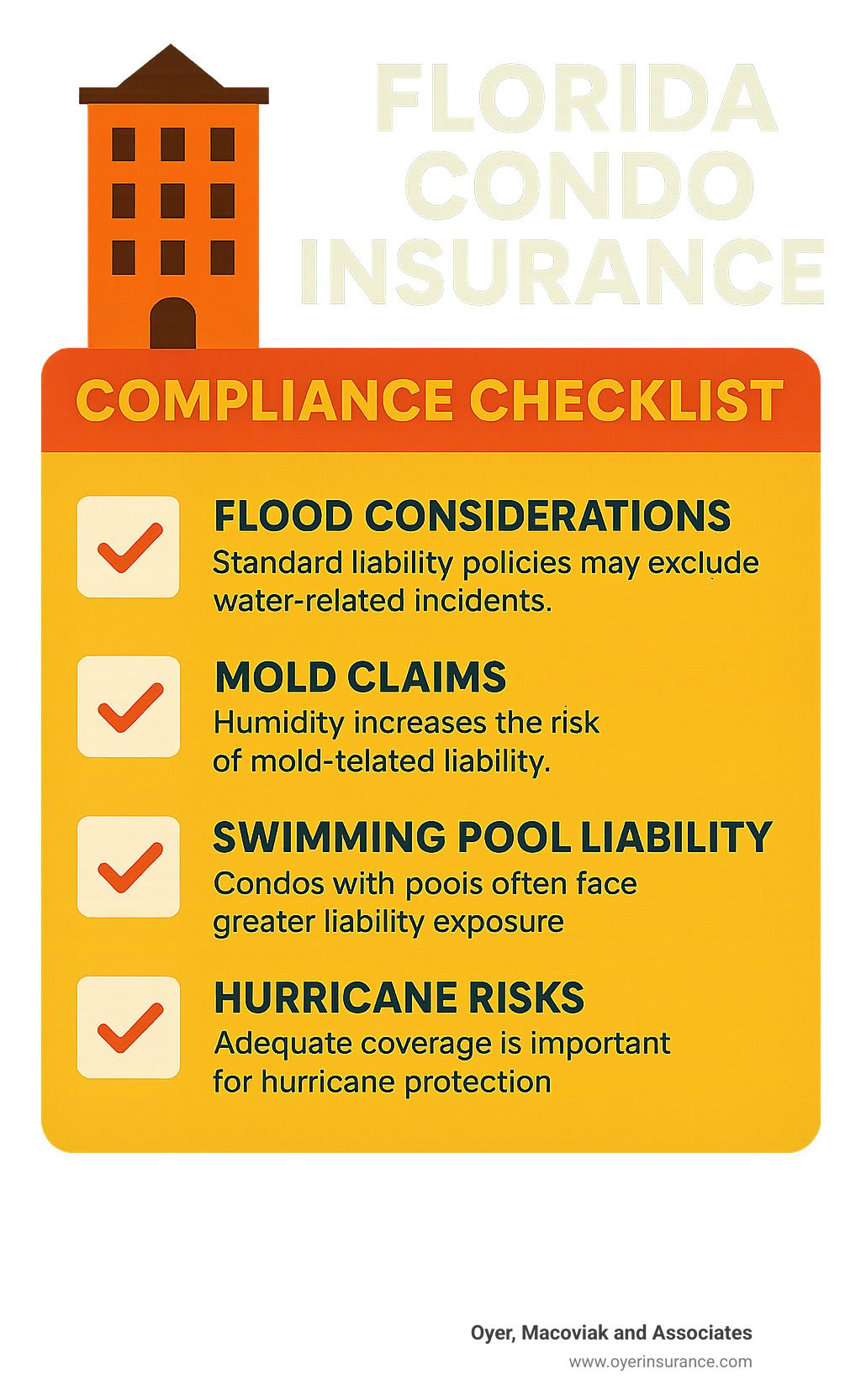
Living in Florida creates unique liability concerns that condo owners elsewhere don’t face. After hurricanes, liability claims often spike due to debris-related injuries, slips and falls from water intrusion, and injuries during emergency repairs. The post-storm period is particularly risky according to research on hurricane injury trends, with significant increases in slip-and-fall injuries and lacerations from debris.
Florida’s flood risk isn’t just about property damage – standard liability policies may exclude certain water-related incidents, making flood insurance an important consideration from a liability perspective too.
The state’s humid climate makes mold a significant concern. Liability related to mold exposure can be complex and is potentially excluded from standard coverage, so it’s worth discussing with your insurance professional.
With year-round swimming weather, Florida condos with pools face heightened liability exposure. If your community has a pool, the association should ensure its liability coverage adequately addresses this high-risk amenity.
At Oyer, Macoviak and Associates, we’ve been helping Florida condo owners steer these complex waters since 1953. We understand that can condos in Florida be required to carry liability insurance is a question with many layers, and we’re here to help you find the right coverage for your specific situation.
For more information about protecting your condo, visit our General Liability Insurance Florida page or learn more about What Does Condominium Insurance Cover?. You can also check the CDC’s guidance on hurricane preparedness, which includes important information about injury prevention during and after storms.
Consequences of Skipping Liability Coverage & How to Stay Compliant
Let’s be honest – nobody likes paying insurance premiums. But when it comes to condo liability coverage in Florida, trying to save a few dollars today could cost you everything tomorrow.
Can condos in Florida be required to carry liability insurance? Yes, and there are serious consequences for those who try to skip this essential protection.
Penalties for Associations
When a condo association fails to maintain proper liability coverage, they’re essentially gambling with every owner’s financial future. The fallout can be devastating:
Your association faces direct financial exposure to liability claims that can easily reach six or seven figures. Imagine a serious injury in your pool area or lobby – without insurance, that settlement comes directly from your community’s funds.
To cover these uninsured claims, boards typically must levy special assessments on all owners. I’ve seen these assessments force retirees to return to work or families to sell their beloved vacation homes when they simply couldn’t afford the unexpected bill.
Board members who neglect insurance requirements aren’t just making a bad decision – they’re potentially breaching their fiduciary duty, opening themselves to personal lawsuits. Even worse, many Directors & Officers policies won’t cover claims arising from failure to maintain required insurance, leaving board members personally exposed.
In today’s challenging Florida insurance market, some associations struggle to find affordable coverage. However, the law’s “best efforts” requirement means boards must explore every possible option before even considering going uninsured. At Oyer, Macoviak and Associates, we’ve helped associations steer these difficult waters since 1953, often finding creative solutions when others couldn’t.
Penalties for Unit Owners
Individual owners face their own set of risks when skipping liability coverage:
Your personal assets become your insurance policy – your savings, investments, retirement accounts, and even future earnings could be seized to satisfy a judgment. I’ve seen owners lose their life savings over what seemed like minor incidents that spiraled into major liability claims.
If your association requires liability insurance (and many do), you might face enforcement actions including fines, liens against your unit, or even suspension of your rights to use common areas like pools or fitness centers. Some associations will purchase “force-placed” insurance on your behalf – often at two or three times the normal premium – and then bill you directly.
Most mortgages require continuous insurance coverage, so letting your policy lapse could trigger a mortgage default. Your lender might then force-place their own coverage (again, at premium rates) or even initiate foreclosure proceedings.
Without the loss assessment coverage that comes with HO-6 policies, you’ll have no protection when the association passes along costs for liability claims that exceed their master policy limits. After Hurricane Ian, I saw owners hit with five-figure assessments that could have been covered by a policy costing just a few hundred dollars annually.
Practical Steps to Verify Coverage
Staying compliant doesn’t have to be complicated. Here’s how to protect yourself and your community:
For Associations:
Schedule an annual policy review with a Florida condo insurance professional who understands the unique risks facing coastal communities. At Oyer, Macoviak and Associates, we specialize in helping boards understand their coverage needs and options.
Document your compliance efforts carefully. Board meeting minutes should reflect discussions about insurance, quotes received, and decisions made – creating a paper trail that demonstrates your “best efforts” to secure appropriate coverage.
Communicate clearly with unit owners about insurance requirements. Many conflicts arise simply because owners don’t understand what coverage they need to maintain. Send regular reminders about minimum liability requirements and deadlines for providing proof of insurance.
Implement a system to track certificates of insurance from all owners. This doesn’t need to be complicated – even a simple spreadsheet can help ensure everyone maintains required coverage.
For Unit Owners:
Take time to review your association documents carefully. The declaration and bylaws will specify exactly what insurance you’re required to carry. Don’t assume – requirements vary widely between communities.
Verify your coverage limits meet or exceed both association and mortgage requirements. The small additional premium for higher liability limits (say, $300,000 instead of $100,000) is one of the best insurance values available.
Provide proof of insurance to your association promptly when requested. Set a calendar reminder for policy renewal dates to avoid compliance issues.
Consider a wind mitigation inspection – in Florida, this simple step can significantly reduce your insurance premiums, often paying for itself many times over.
When it comes to Florida condo insurance, working with professionals who understand the unique challenges of our state makes all the difference. At Oyer, Macoviak and Associates, we’ve been helping Florida condo associations and unit owners steer these waters since 1953, providing personalized solutions that protect what matters most.
Remember – the right liability coverage isn’t just about meeting requirements. It’s about sleeping soundly, knowing you’re protected from whatever tomorrow might bring.
Frequently Asked Questions about Liability Insurance for Florida Condos
Are Florida condo associations legally required to carry liability insurance?
Yes. Florida Statute 718.111(11) makes it clear that condominium associations must maintain liability insurance for all common areas and shared spaces. This isn’t optional—it’s a mandatory requirement under the Florida Condominium Act. Boards that fail to maintain this coverage are actually breaching their fiduciary duty to the association.
While the law doesn’t spell out exact dollar amounts for coverage, most industry professionals recommend a minimum of $1 million per occurrence. Many Florida associations choose higher limits based on their specific risks—things like swimming pools, fitness centers, or beachfront locations often warrant additional protection.
This requirement applies to every residential condo association in Florida—from small buildings with just a few units to massive high-rises with extensive amenities. Even if your association has minimal common areas, you still need appropriate liability coverage. At Oyer, Macoviak and Associates, we’ve helped associations of all sizes find the right balance of protection and affordability since 1953.
How can bylaws force individual owners to purchase HO-6 liability coverage?
While Florida law doesn’t directly require unit owners to carry liability insurance, your association’s governing documents absolutely can—and many do. These requirements have real teeth because of how condominium ownership works.
When you buy a condo, you’re agreeing to follow all the rules in the declaration and bylaws—it’s essentially a contract. If those documents require you to maintain an HO-6 policy with liability coverage, you’re obligated to comply.
Associations can enforce these requirements through several channels. They might impose monetary fines, place liens against your unit, or take legal action to enforce the covenant. In serious cases of non-compliance, some associations even have the power to begin foreclosure proceedings.
Many bylaws also allow the association to purchase “force-placed” insurance if you don’t maintain required coverage. They’ll simply buy a policy on your behalf and bill you for it—usually at premium rates plus administrative fees. It’s much more cost-effective to secure your own coverage.
For these requirements to hold up, they need to be clearly stated in the governing documents. Vague language about “adequate insurance” might be difficult to enforce, which is why we recommend associations work with professionals who understand how to properly structure these requirements.
What happens if a claim exceeds the association’s liability limit?
When a liability claim goes beyond your association’s insurance limits, the situation can quickly become complicated and potentially costly for everyone involved.
If your association wisely invested in excess or umbrella liability coverage, those policies would kick in after the primary liability limits are exhausted—providing an additional layer of protection. This is why we often recommend umbrella policies to our association clients.
Without sufficient insurance, though, the association would likely need to impose a special assessment on all unit owners to cover the remaining liability. This can come as a shocking financial hit, especially if the claim is substantial.
This is where individual unit owners’ HO-6 policies become crucial. Most include loss assessment coverage (Florida requires a minimum of $2,000), which helps cover your share of such an assessment. Can condos in Florida be required to carry liability insurance for unit owners? Yes—and this scenario shows exactly why that requirement makes sense.
In severe cases where an association’s coverage is deemed inadequate due to negligence, individual board members might even face personal liability exposure—a situation no volunteer board member wants to experience.
The takeaway here is clear: associations should carry robust liability limits with umbrella coverage, while unit owners need their own HO-6 policies with sufficient loss assessment protection. At Oyer, Macoviak and Associates, we recommend regular reviews of all coverage limits to ensure they align with current risk exposures and replacement costs.
For more information about liability claims and insurance requirements, you can visit the Insurance Information Institute, which provides excellent resources on various insurance topics including condominium coverage.
Conclusion & Next Steps
So, can condos in Florida be required to carry liability insurance? As we’ve seen throughout this article, the answer is absolutely yes—and for good reason. Associations must carry liability insurance by state law, while individual owners may be required to maintain coverage through their association’s governing documents and mortgage requirements.
The reality is that Florida’s unique risks—from hurricanes to slip-and-fall accidents around the pool—make liability coverage not just a legal requirement but a practical necessity. Going without proper coverage puts everything at stake, from your community’s financial health to your personal assets.
With Florida’s insurance market facing ongoing challenges, staying informed and proactive about your coverage needs is more important than ever. The peace of mind that comes from knowing you’re properly protected is truly invaluable.
For association boards, we recommend scheduling an annual insurance review with a professional who understands the nuances of Florida condominium coverage. Make sure you’re clearly communicating requirements to all unit owners and tracking compliance. Consider whether your current liability limits truly reflect your community’s risk exposure—especially if you have amenities like pools, fitness centers, or host community events.
For individual unit owners, take time to understand what your association requires and what your mortgage lender mandates. Your HO-6 policy should include appropriate liability limits and loss assessment coverage (preferably above Florida’s $2,000 minimum). Your personal policy protects what the association policy doesn’t—the interior of your unit and your personal liability.
Here at Oyer, Macoviak and Associates, we’ve been helping Florida condo associations and unit owners steer these waters since 1953. Our team understands the delicate balance between comprehensive protection and affordability. With access to over 30 “A” rated insurance companies, we can find options custom to your specific situation.
Don’t wait until after a claim to find gaps in your liability coverage. A simple conversation today can prevent significant headaches tomorrow. Whether you’re a board member ensuring compliance with Florida law or an individual owner trying to understand your obligations, we’re ready to help you create a personalized protection plan.
Ready to make sure your condo liability coverage meets all requirements? Learn more about Florida condo insurance rates or reach out to our team for a friendly, no-pressure conversation about your specific needs. After all, we’ve been creating personalized policies since 1953—we’d love to create one for you too.

Robert Macoviak is the President of Oyer, Macoviak and Associates. Oyer, Macoviak and Associates is the oldest independent insurance agency in Boynton Beach and has been in business since 1953. Oyer, Macoviak and Associates are vested members of the community who are committed to doing business face-to-face and being your insurance advocate in times of need.