
Insurance Resources
Uninsured & Undaunted: Your Guide to Eye Exam Costs
Discover how much is a vision exam without insurance. Find average costs, discounts, and affordable care options in this guide.

Understanding Eye Exam Costs Without Insurance
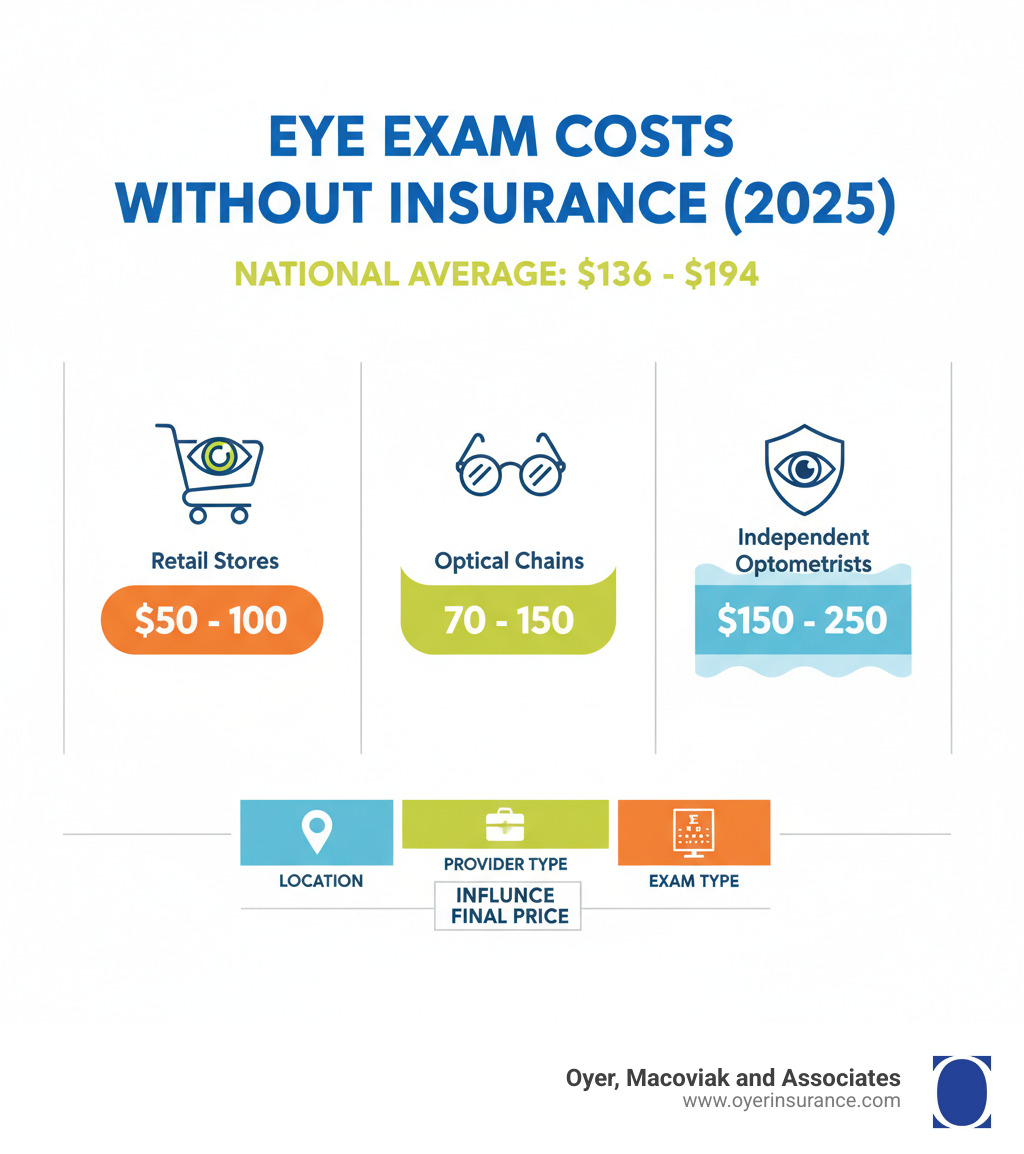
How much is a vision exam without insurance? On average, you can expect to pay between $50 and $200 for a standard eye exam without insurance, with the national average hovering around $136 to $194. New patients typically pay more ($171-$200), while returning patients often pay less (around $128). The exact cost depends on where you go, what tests you need, and your geographic location.
Quick Cost Breakdown:
- Retail stores (Walmart, Target, Sam’s Club): $45-$100
- Optical chains (LensCrafters, Pearle Vision): $70-$150
- Independent optometrists: $150-$250
- Additional tests (retinal imaging, contact lens fitting): $35-$250 extra
Eye health matters. Regular eye exams don’t just help you see clearly—they can detect serious conditions like glaucoma, cataracts, and even signs of diabetes or high blood pressure. But for many people, the cost of an exam without insurance feels like a roadblock.
Getting annual eye exams can help prevent serious eye conditions from happening later. However, proactively taking care of your eye health isn’t always inexpensive. That’s why understanding your options matters.

Ready for a Quote?
Since 1953, Oyer, Macoviak and Associates has helped clients compare insurance options while our independent agency does the shopping work. Tell us what you need once, and we can help review options from more than 30 rated insurance companies.
or Call (561) 732-9305
This guide breaks down exactly what you’ll pay for a vision exam without insurance. We’ll explain what influences the price, where to find affordable care, and what programs might help reduce your costs. Whether you’re visiting a retail chain or an independent optometrist, you’ll know what to expect before you book.
As Rob Macoviak, owner of Oyer, Macoviak and Associates, I’ve helped countless families in Boynton Beach find affordable insurance solutions for their vision care needs. While exploring how much is a vision exam without insurance, many clients find that understanding their options—from discount programs to supplemental vision plans—makes eye care much more accessible than they initially thought.
The Bottom Line: Average Eye Exam Costs Without Insurance
If you don’t have vision insurance, understanding what you’ll actually pay for an eye exam helps take some of the stress out of scheduling that important appointment. Let’s break down the numbers so you know exactly what to expect.
Across the United States, how much is a vision exam without insurance typically falls between $136 and $194. This is the middle ground—most people will pay somewhere in this range for a standard comprehensive exam. Of course, your actual cost might be higher or lower depending on where you go and what your eyes need.
Here’s something interesting: whether you’re a new patient or a returning one can make a real difference in your wallet. If it’s your first visit to a particular eye care provider, expect to pay a bit more—usually between $171 and $200. That initial exam tends to be more comprehensive as the doctor establishes a baseline for your eye health and gets to know your vision history.
The good news? Once you become a regular patient, those costs often drop. Returning patients typically pay around $128 for their annual exams. Many practices appreciate patient loyalty and reflect that in their pricing for follow-up visits.
And if you’re really watching your budget, you’ll be happy to know that eye exams can start as low as $50 in some locations. These lower-priced options are usually found at retail optical centers and warehouse clubs, which we’ll explore more in just a moment.
The key takeaway? While the national average gives you a baseline, your actual cost depends on several factors—and knowing what influences these prices can help you find an affordable option that doesn’t compromise on quality care.

What Factors Influence the Price of an Eye Exam?
Understanding what drives eye exam costs helps you make smarter choices about where to get your vision checked. Several key factors determine what you’ll pay out of pocket.
Provider type is probably the biggest influence on your final bill. A retail optical center inside Walmart will charge differently than an independent optometrist with their own practice. Each type of provider has different overhead costs, which naturally affects their pricing structure.
Geographic location plays a surprisingly large role too. If you’re getting your eyes examined in a busy Florida city like Miami or West Palm Beach, you’ll likely pay more than someone visiting a small-town practice in rural Tennessee. Metropolitan areas simply have higher operating costs—rent, utilities, staff salaries—and those expenses get reflected in exam fees. The same holds true across our service areas in Georgia and North Carolina.
The type of exam you need also matters significantly. A quick vision screening to update your glasses prescription costs much less than a comprehensive eye health examination that checks for glaucoma, cataracts, and other conditions. If you need specialized testing for contact lenses or have specific concerns about your eye health, expect additional charges.
Finally, your patient status affects pricing. As we mentioned earlier, new patients usually pay more than established patients. That first visit involves more paperwork, a more thorough health history review, and often a more extensive examination.
Here’s how costs typically break down by provider type:
| Provider Type | Typical Cost Range (without insurance) | Notes |
|---|---|---|
| Retail Stores (e.g., Walmart, Sam’s Club, America’s Best) | $45 – $100 | Often the most affordable, sometimes with promotional bundles for eyewear. |
| Warehouse Clubs (e.g., Costco, BJ’s) | $50 – $75 | Members-only pricing; consistently low costs. |
| Optical Chains (e.g., LensCrafters, Pearle Vision) | $70 – $150 | Mid-range pricing with convenient locations and extended hours. |
| Independent Optometrists | $150 – $250 | Higher cost but often more personalized care and flexible scheduling. |
How do additional tests affect the price?
A standard comprehensive eye exam covers the essentials of vision and eye health, but sometimes your optometrist will recommend additional tests. These specialized screenings provide deeper insights into your eye health, though they do add to the total cost.
A standard comprehensive exam typically includes the basics you’d expect. The visual acuity test—that familiar eye chart where you read progressively smaller letters—measures how clearly you see at different distances. The refraction test is the part where your doctor asks “which is better, one or two?” as they flip through different lenses to determine your exact prescription. You’ll also get a glaucoma screening to check the pressure inside your eyes, which helps detect this sight-threatening condition early.
Beyond these basics, your eye doctor might suggest additional testing based on your age, symptoms, or risk factors. Retinal imaging has become increasingly common and valuable. This technology captures detailed digital photographs of the back of your eye, allowing your doctor to spot early signs of problems like macular degeneration, diabetic retinopathy, or retinal tears. While incredibly useful, retinal imaging typically adds $35 to $40 to your exam cost.
Pupil dilation is another common add-on. Your doctor uses special eye drops to widen your pupils, providing a clearer view of your retina and optic nerve. Some practices include this as part of their standard comprehensive exam, while others offer it as an alternative to retinal imaging or an additional service.
If you have specific concerns—like diabetes, high blood pressure, or a family history of eye disease—your doctor might recommend visual field testing or optical coherence tomography (OCT). These advanced tests provide detailed information about your eye health but will increase your out-of-pocket costs.
Don’t hesitate to ask your optometrist about any recommended tests. Understanding why they’re needed and what they cost helps you make informed decisions about your eye care. While these additional tests increase the immediate expense, they can catch serious problems early when they’re much easier—and less expensive—to treat.
Navigating the Costs of a Contact Lens Exam
If you wear contact lenses or you’re thinking about making the switch from glasses, here’s something important to know: how much is a vision exam without insurance changes significantly when contacts enter the picture. A contact lens exam isn’t just a standard eye exam—it’s a specialized service that requires additional testing and follow-up care, which means additional costs.
Why does a contact lens exam cost more? Think of it this way: your standard eye exam determines your glasses prescription and checks your overall eye health. That’s valuable, but contact lenses sit directly on your eye, so your optometrist needs to do quite a bit more work to ensure they’re safe, comfortable, and effective for you.
During a contact lens fitting and evaluation, your optometrist will measure the curvature of your cornea (the front surface of your eye) and the size of your pupil and iris. These measurements help determine the right base curve and diameter for your lenses. Your doctor will also evaluate your tear film—basically, how moist your eyes are—to make sure they can comfortably handle wearing contacts. Some eyes are naturally drier, and that matters when you’re putting a lens directly on the surface.
You’ll typically receive trial lenses to wear for a week or two. This isn’t just a courtesy—it’s a crucial step. What looks good in the exam room might feel different after a full day of wear. You need to know how the lenses feel during your normal activities, whether they stay in place when you blink, and if your vision remains clear throughout the day.
After you’ve worn the trial lenses, you’ll come back for a follow-up visit. Your optometrist will check how the lenses are sitting on your eyes, look for any signs of irritation or complications, and confirm that your vision is sharp. Only after this follow-up will your contact lens prescription be finalized. This is different from your glasses prescription, by the way—the two aren’t interchangeable.
All of these extra steps—the specialized measurements, the trial lenses, and the follow-up care—add an extra $100 to $250 on top of your standard eye exam cost. So if you’re paying around $150 for a comprehensive eye exam, you could be looking at $250 to $400 total for a contact lens exam without insurance.
It might feel like a lot, but think of it as an investment in both your vision and your eye health. Poorly fitted contact lenses can cause serious problems, from chronic discomfort to infections and even corneal damage. The extra cost ensures you’re getting lenses that work with your unique eyes, not against them.

When you’re budgeting for eye care without insurance, make sure to factor in this contact lens exam fee if you need or want contacts. And don’t hesitate to ask your optometrist’s office about the total cost upfront—they should be able to give you a clear breakdown before your appointment.
Finding Affordable Eye Care: Discounts, Programs, and Savvy Shopping
Even without vision insurance, there are many ways to make eye care more affordable. We understand that managing healthcare costs is a priority for families and businesses in Florida, Georgia, North Carolina, and Tennessee, and we’re here to help you steer these options.

How much is a vision exam without insurance if I use a discount?
Taking advantage of discounts and promotions can significantly reduce how much a vision exam without insurance will cost you. The key is knowing where to look and what to ask for.
Retail promotions and bundled deals are often your best friend when shopping for affordable eye care. Many large retail optical centers, like America’s Best, offer promotions where you can get a “free” eye exam (often valued at around $69) with the purchase of two pairs of glasses. Other retailers might have similar bundled deals on exams and eyewear. These can be excellent options if you know you’ll also be purchasing new glasses.
Vision discount plans are another smart alternative, though they’re not insurance. For an annual fee (often ranging from $5-$35 a month), you receive discounts on eye exams, glasses, and contacts from participating providers. For example, some plans might offer an eye exam for $80 that would normally cost $134, saving you $54. While not insurance, these plans can provide predictable savings without the commitment of monthly insurance premiums.
Don’t be afraid to simply ask if there are any cash discounts available if you’re paying out-of-pocket. Some independent practices may offer a small reduction for upfront payment.
We always recommend calling several optical offices near you to compare prices. To get a better sense of typical costs in your specific area, you can also use resources like Check local costs with FAIR Health Consumer.
Are there programs to help with eye exam costs?
Absolutely! Several programs and resources are available to help individuals and families, especially those with limited income or specific needs, access affordable or even free eye care. These programs are invaluable for ensuring that cost isn’t a barrier to healthy vision.
EyeCare America, offered by the American Academy of Ophthalmology, provides eye care services to eligible seniors (65 and older) and those at increased risk for glaucoma. This often includes a free eye exam. InfantSEE is a public health program that provides free, comprehensive eye health assessments for infants aged 6 to 12 months, regardless of a family’s income or access to insurance.
New Eyes is an organization that purchases new prescription glasses for financially impoverished children and adults in the United States. Sight for Students, provided by Vision Service Plan (VSP), offers free eye exams and glasses to low-income, uninsured children.
Government programs like Medicaid can also help. If you have low income, check with your state’s Medicaid program. Depending on the state (including Florida, Georgia, North Carolina, and Tennessee), Medicaid may offer vision benefits, especially for children. For adults, coverage can vary but is worth investigating. To learn more about how Health Insurance, including government programs, might play a role, you can visit our health insurance page.
These programs demonstrate that there are compassionate solutions for those struggling with eye care costs. For a broader overview of available assistance, you can also Learn about programs from the National Eye Institute.
Is Vision Insurance a Better Option?
For many, the question isn’t just how much is a vision exam without insurance, but whether investing in vision insurance makes financial sense. While you might initially be hesitant about another monthly premium, vision insurance can often lead to significant savings over time, especially if you or your family members require regular eye care or new eyewear annually.
Vision insurance is a supplemental health insurance plan designed specifically to help cover the costs associated with routine eye care. It works much like other insurance plans: you pay a regular monthly premium, and in return, you receive benefits that reduce your out-of-pocket expenses for eye exams, glasses, and contact lenses.
Monthly premiums can vary based on the plan and coverage level, but they are typically quite affordable, often adding up to around $150-$200 annually. For an eye exam, most vision insurance plans will require a small copay, typically ranging from $10 to $40. This is a stark contrast to the $50-$200+ you might pay without insurance. Many plans also include allowances or discounts for frames, lenses, and contact lenses, often covering a significant portion of the cost.
Consider this: if you pay $150 for an eye exam and another $200 for glasses each year without insurance, that’s $350 out-of-pocket. With a vision insurance plan costing $200 annually and a $20 copay for the exam, plus a generous allowance for glasses, your total cost could be much lower. If your plan covers frames up to $130 and offers discounts on lenses, your out-of-pocket for glasses might be minimal.
Vision insurance is often separate from your standard health insurance, similar to how Dental Insurance works as a supplemental plan. We’ve found that for our clients across Florida, Georgia, North Carolina, and Tennessee, having a dedicated vision plan often makes eye care more accessible and predictable, removing the financial stress of unexpected costs. It’s about proactive care and peace of mind.
Frequently Asked Questions about Eye Exam Costs
We hear a lot of questions from clients across Florida, Georgia, North Carolina, and Tennessee about eye exams and what they cost, especially when insurance isn’t in the picture. Let’s address some of the most common concerns we encounter.
How often should I get an eye exam?
Here’s the straightforward answer: most adults should plan on getting their eyes checked annually. Think of it like your regular dental cleaning or physical checkup—it’s preventive care that keeps small problems from becoming big ones.
But the real answer depends a bit on where you are in life. Children need regular vision screenings starting in infancy, then periodically throughout childhood. Before they start school and then every year after is a good rule of thumb. If you’re a younger adult in your 20s or 30s with healthy eyes, you might get away with less frequent visits—once in your 20s and twice in your 30s is often enough. But once you hit 40, that changes. This is when age-related vision issues start creeping in, so bumping it up to every one to two years makes sense.
For seniors 65 and older, regular exams become even more important. Conditions like cataracts, glaucoma, and macular degeneration become more common, and early detection is key. If you’re in this age group, it’s worth exploring how Medicare Supplement Insurance might help with overall healthcare costs.
Now, if you have diabetes, high blood pressure, a family history of eye disease, or you’re taking medications that can affect your eyes, your eye doctor will likely want to see you more often. Here’s something many people don’t realize: eye exams can actually detect signs of diabetes, high blood pressure, and other health issues before you even know you have them. It’s one more reason not to skip them.
Can I use my regular health insurance for an eye exam?
This confuses a lot of people, so let’s clear it up. For a routine eye exam—the kind where you’re just updating your prescription for glasses or checking that everything looks healthy—your regular health insurance typically won’t cover it. That’s because vision care is usually considered a separate benefit, which is why vision insurance exists as its own thing.
However, if you’re visiting the eye doctor for a medical reason, that’s a different story. Your standard Health Insurance will generally step in to cover exams related to conditions like glaucoma, cataracts, diabetic retinopathy, eye infections, injuries, or sudden vision changes. Basically, if it’s about treating or monitoring an eye disease or medical problem, your health insurance should cover it.
There’s one important exception worth knowing about: pediatric vision. Thanks to the Affordable Care Act, health insurance plans are required to include vision coverage for children under 19 as an essential health benefit. So if you’re wondering how much is a vision exam without insurance for your kids, check your health plan first—you might already have coverage.
Will I get my prescription after the exam?
Absolutely, yes. This is one thing you don’t need to worry about, whether you’re paying out-of-pocket or using insurance. Federal law requires eye care providers to give you a copy of your prescription after your exam. It’s your right, plain and simple.
For glasses, you should walk out of your appointment with your prescription in hand. This gives you the freedom to shop around for frames and lenses wherever you want—whether that’s online, at a big box store, or back at the same office. It’s your choice, and having that prescription means you control where your money goes.
For contact lenses, the process takes a bit longer. You’ll get a preliminary prescription, but the final version comes after a follow-up appointment. This isn’t anyone trying to make things difficult—it’s actually an important safety step. The follow-up ensures the contacts fit properly and aren’t causing any irritation or damage to your eyes. This is part of why contact lens exams cost more, but it’s protecting your eye health in the long run.
Don’t ever hesitate to ask for your prescription. It’s yours, and any reputable provider will hand it over without question. At Oyer, Macoviak and Associates, we believe in empowering our clients with information and choices, whether that’s about insurance or about getting the most value from your healthcare spending.
Take Control of Your Vision Health and Costs
Navigating eye care without insurance can feel like trying to read a blurry sign, but as we’ve explored, it’s entirely possible to get the care you need without breaking the bank. From understanding the average costs and the factors that influence them, to finding promotional deals, discount plans, and charitable programs, you have many tools at your disposal.
Regular eye exams are not just about seeing clearly; they are a vital component of your overall health. They can detect serious eye diseases early and even reveal signs of systemic conditions like diabetes or hypertension. Don’t let the perceived cost be a barrier to maintaining this essential aspect of your well-being.
At Oyer, Macoviak and Associates, we pride ourselves on being professionals dedicated to providing personalized insurance solutions for families and businesses across Florida, Georgia, North Carolina, and Tennessee. We understand the importance of affordable healthcare, and that includes vision. While we can’t offer you a free eye exam, we can help you find vision insurance plans that make eye care more accessible and budget-friendly in the long run.
We believe that everyone deserves clear sight and healthy eyes. Don’t let cost keep you from getting the care you need. If you’re curious about how vision insurance can benefit you, or if you’re exploring broader health coverage options, we’re here to help. For instance, if you’re wondering How much is health insurance per month in Florida?, our team can provide custom information and quotes.
Take the first step towards clearer vision and a healthier future.

Explore Vision Insurance Plans

Robert Macoviak is the President of Oyer, Macoviak and Associates. Oyer, Macoviak and Associates is the oldest independent insurance agency in Boynton Beach and has been in business since 1953. Oyer, Macoviak and Associates are vested members of the community who are committed to doing business face-to-face and being your insurance advocate in times of need.