
Insurance Resources
A Comprehensive Guide to Homeowners Insurance Coverage
Master Homeowners Insurance with our comprehensive guide. Learn coverage, costs, and how to protect your home. Get a free quote!

Why Understanding Homeowners Insurance Coverage Is Critical
Homeowners Insurance is a policy that provides financial protection for your home’s structure, personal belongings, and liability risks. It also covers temporary living expenses if a covered event makes your home uninhabitable.
Quick Overview of Homeowners Insurance Coverage:
- Dwelling Coverage (A) – Protects your home’s structure.
- Other Structures Coverage (B) – Covers detached garages, sheds, and fences.
- Personal Property Coverage (C) – Protects your belongings like furniture and electronics.
- Loss of Use Coverage (D) – Pays for temporary living expenses.
- Personal Liability Coverage (E) – Protects against lawsuits from injuries on your property.
- Medical Payments Coverage (F) – Covers guest medical bills regardless of fault.
Your home is your most valuable asset, and understanding your coverage is key to protecting your family’s financial future. Most mortgage lenders require homeowners insurance, but even if you own your home outright, it’s a crucial safety net against disasters, theft, and liability claims.
Premiums vary based on location, your home’s age, and coverage choices. With the right knowledge, you can select appropriate coverage levels and find ways to save money.

Ready for a Quote?
Since 1953, Oyer, Macoviak and Associates has helped clients compare insurance options while our independent agency does the shopping work. Tell us what you need once, and we can help review options from more than 30 rated insurance companies.
or Call (561) 732-9305
As Rob Macoviak, owner of Oyer, Macoviak and Associates, I’ve helped countless families in Florida steer the complexities of Homeowners Insurance since taking over our family business in 2006. With over 17 years of experience in the insurance industry, I understand that each homeowner’s needs are unique, which is why personalized coverage solutions are essential for true peace of mind.

Common Homeowners Insurance vocab:
What is Homeowners Insurance and Why Is It Essential?
Homeowners Insurance is a financial safety net for your biggest investment: your home. It protects you from unexpected events like fires, storms, or theft. (For a broader overview, see the Home insurance entry on Wikipedia.) This comprehensive coverage protects your home’s structure, your personal belongings, and provides liability protection if someone is injured on your property. It can also cover additional living expenses if you need to temporarily move out while repairs are made.
Without it, a single disaster could be financially devastating. Most families cannot afford to rebuild their home or replace all their belongings out of pocket. This coverage is essential for protecting your family’s financial future. For more details, see our article on 5 Reasons You Should Get Homeowners Insurance.
The Role of Home Insurance in Mortgages
If you have a mortgage, your lender will require you to carry Homeowners Insurance. Your home is the collateral for the loan, and the lender needs to protect their investment. If your house were destroyed without insurance, the lender would lose their security.
Lenders specify minimum coverage amounts and require proof of insurance before closing. If your policy lapses, they can purchase expensive force-placed coverage on your behalf, which primarily protects them, not you. Many homeowners pay their insurance premiums through an escrow account as part of their monthly mortgage payment, ensuring timely payments. It’s wise to shop for insurance early in the home-buying process, as explained in our guide on Why You Need To Shop For Home Insurance While Buying A Home.
Key Insurance Terms You Should Know
Understanding basic insurance terms helps you make better decisions.
- Policy: The legal contract between you and the insurer detailing what is covered.
- Premium: The amount you pay for your insurance coverage.
- Deductible: Your out-of-pocket expense on a claim before the insurance pays. For example, with a $1,000 deductible on a $5,000 claim, you pay $1,000 and the insurer pays $4,000.
- Peril: The cause of damage, such as fire, theft, or a windstorm.
- Limit: The maximum amount an insurer will pay for a specific type of loss.
- Endorsement: An add-on that modifies your standard policy, also called a rider.
- Declarations Page: A summary of your policy, showing coverage limits, deductibles, and other key information.
Deconstructing Your Standard Homeowners Insurance Policy
A standard Homeowners Insurance policy includes six main coverage areas, labeled A through F. Your declarations page lists these coverages and their limits, acting as a cheat sheet for your policy. For a detailed look at what’s included, see our guide on What Does Standard Homeowners Insurance Cover.
Coverage A & B: Dwelling and Other Structures
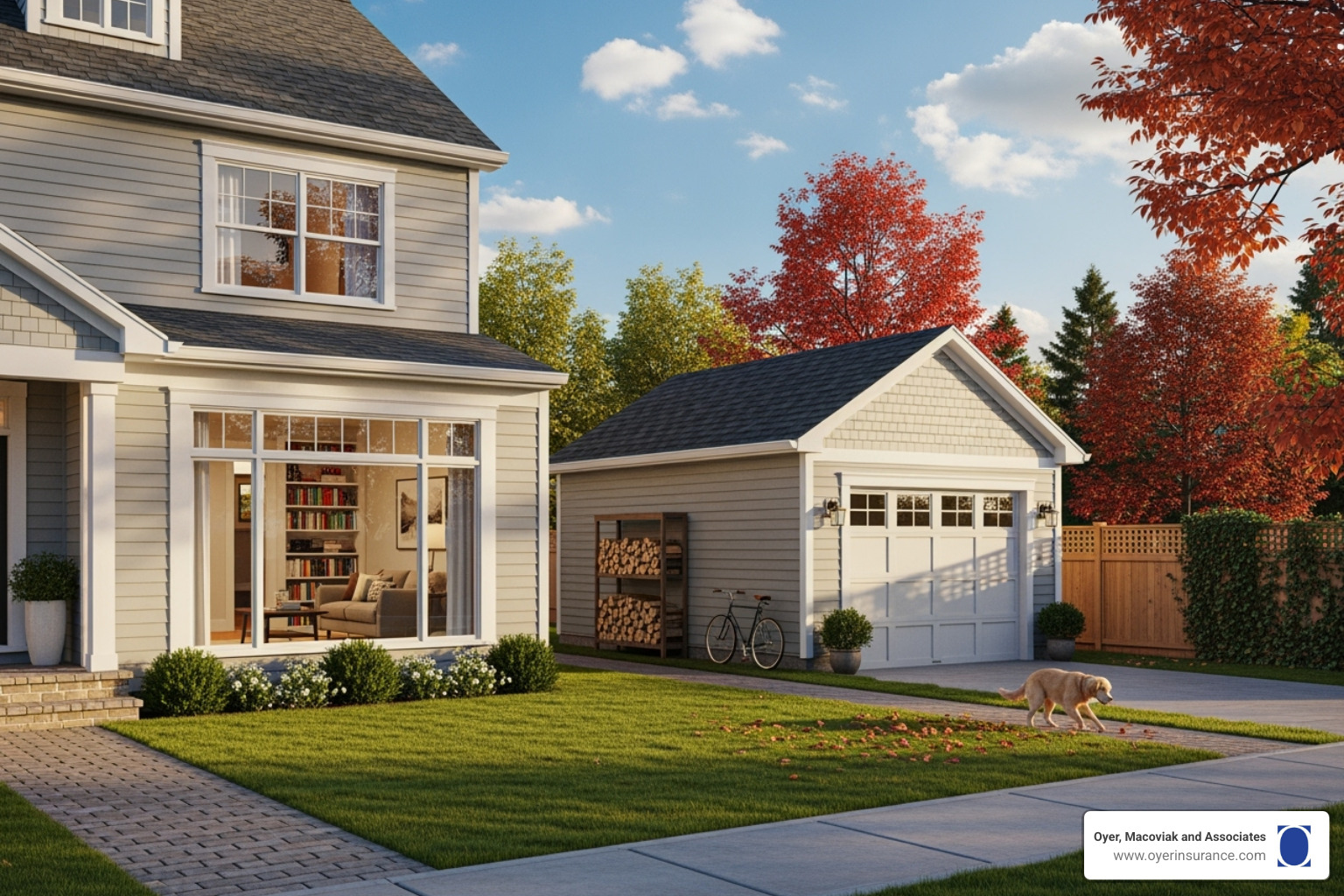
Coverage A: Dwelling protects the physical structure of your house, including the walls, roof, and attached features like a garage or deck. Your dwelling coverage amount should reflect the cost to rebuild your home, not its market value.
Coverage B: Other Structures covers detached buildings on your property, such as a freestanding garage, shed, or fence. This coverage is typically set at 10% of your dwelling coverage. If you have valuable detached structures, you may need to increase this limit.
Coverage C: Personal Property
Coverage C protects your belongings, such as furniture, clothing, and electronics. This protection often extends to items outside your home, like a laptop stolen from your car. Coverage is usually 50% to 70% of your dwelling coverage. Learn more in our guide to Home And Contents Insurance.
Be aware of special limits on high-value items like jewelry or firearms. If your valuables exceed these standard limits, you can add extra coverage with a “scheduled personal property” endorsement. A home inventory can be invaluable during a claim; see our guide on How Having A Home Inventory Can Help You During An Insurance Claim.
Coverage D: Loss of Use / Additional Living Expenses
Coverage D, or Loss of Use, pays for the necessary increase in living expenses if a covered loss makes your home uninhabitable. This can include hotel bills, temporary rent, and restaurant meals that exceed your normal grocery budget. The limit is typically 20% of your dwelling coverage.
Coverage E & F: Personal Liability and Medical Payments

Coverage E: Personal Liability protects you financially if you’re found legally responsible for injuring someone or damaging their property. This covers legal defense and damages, with standard limits from $100,000 to $500,000. We offer comprehensive Personal Liability Insurance Florida to manage these risks.
Coverage F: Medical Payments covers medical bills for guests injured on your property, regardless of fault. This “no-fault” coverage, typically $1,000 to $5,000, can help resolve minor incidents before they become large liability claims.
Replacement Cost vs. Actual Cash Value

How your property is valued after a loss significantly affects your payout.
- Replacement Cost (RCV) pays to repair or replace your property with new materials of similar quality, without deducting for depreciation.
- Actual Cash Value (ACV) pays the value of your property just before the loss, factoring in depreciation. An old roof or sofa would be valued at its depreciated worth, not the cost of a new one.
We generally recommend RCV for more complete protection. Options like “Extended Replacement Cost” can provide additional coverage if rebuilding costs rise unexpectedly after a widespread disaster. Learn more in our article on Home Insurance Replacement Value Vs Market Value What To Choose.
Understanding Policy Types, Costs, and Customizations for your Homeowners Insurance
Choosing the right Homeowners Insurance is about balancing protection and affordability. Policies come in different forms, and understanding what drives your premium costs helps you make an informed decision.

Different Levels of Home Insurance Coverage
Policies are not one-size-fits-all. The most common types include:
- Basic/Named Peril (HO-1, HO-2): These restrictive policies only cover perils specifically listed in the policy.
- Broad Form (HO-3): The most popular choice. It provides “open perils” coverage for your dwelling (covering everything unless excluded) and “named perils” coverage for your personal property. See our comparison of DP3 And HO3 Property Insurance Policies.
- Comprehensive/All-Risk (HO-5): The most extensive coverage, with “open perils” protection for both your dwelling and personal property.
- Condo (HO-6) and Renters (HO-4): Policies designed specifically for condo owners and tenants.
How Your Homeowners Insurance Premium is Calculated
Your premium is a calculated assessment of risk. Key factors include:
- Location: Proximity to fire services, local crime rates, and exposure to natural disasters like hurricanes.
- Home Characteristics: The age, construction materials, and condition of your home.
- Your Profile: Your claims history and, in many states, your credit score.
- Property Features: “Attractive nuisances” like pools or trampolines can increase liability risk and premiums.
For more details, see our guides on How Much Does Home Insurance Cost In Florida and Factors That Can Affect Your Homeowners Insurance Premiums.
How Deductibles Affect Your Premium
Your deductible is the amount you pay out-of-pocket on a claim.
- A higher deductible lowers your annual premium but means you pay more when you file a claim.
- A lower deductible increases your premium but reduces your out-of-pocket cost per claim.
In coastal areas, you may have a separate, higher percentage deductible for hurricanes. Choose a deductible you can comfortably afford from your emergency fund. Understanding When Not To File A Claim can also help keep premiums stable.
How to Save Money on Home Insurance
You can reduce your premiums without sacrificing protection.
- Bundle Policies: Combining your home and auto insurance with one company can lead to significant savings. Learn about The Benefits Of Bundling Your Home And Auto Insurance.
- Install Safety Devices: Burglar alarms, smoke detectors, and deadbolt locks can earn you discounts.
- Improve Your Home: Updating your roof, plumbing, or electrical systems can lower your risk and your premium.
- Shop Around: Rates change, so it’s smart to compare options. We can shop our network of over 30 “A” rated companies for you.
- Wind Mitigation: In hurricane-prone areas like Florida, features like storm shutters and reinforced roofs can lead to substantial Florida Home Insurance Discounts.
Navigating Common Perils, Exclusions, and Special Coverages
Knowing what your Homeowners Insurance policy covers—and what it doesn’t—is critical. This knowledge can save you from surprises when you need your insurance most.
Common Covered vs. Excluded Perils
A standard policy protects you from sudden, unexpected events.
- Covered Perils typically include fire, lightning, windstorm, hail, theft, vandalism, falling objects, and damage from the weight of ice or snow.
- Excluded Perils almost always include floods, earthquakes, neglect, pest infestations, war, and nuclear hazards. Damage from mold may also have limitations, as explained in our guide on An Overview Of Mold Limitations And Caps In Home Insurance Policies.
The Truth About Water Damage, Floods, and Sewer Backup
Water damage coverage can be confusing. Your policy typically covers sudden and accidental water damage, like a burst pipe. For more details, read our guide on Does My Homeowners Insurance Cover Water Damage.
However, standard policies do not cover flood damage from overflowing rivers, storm surges, or heavy rain. For this, you need a separate flood insurance policy, often through the National Flood Insurance Program (NFIP). You can learn more from the official consumer’s guide to the National Flood Insurance Program. Given the risks in Florida, we strongly recommend reading Why You Should Purchase Flood Insurance If You Live In Florida.
Damage from sewer backup is also often excluded, but you can typically add an endorsement for this coverage.
How Condo and Renters Insurance Differ
- Condo Insurance (HO-6) is “walls-in” coverage for condo owners. It protects your personal belongings, interior structures, and liability, supplementing the master policy held by the condo association. It also includes loss assessment coverage. Learn more about The Difference Between Condo And Home Insurance.
- Renters Insurance (HO-4) is for tenants. It protects your personal property and provides liability coverage, as your landlord’s policy only covers the building itself.
Popular Endorsements to Customize Your Policy
Endorsements (or riders) allow you to tailor your policy to your specific needs.
- Scheduled Personal Property: Provides higher, broader coverage for valuables like jewelry, art, or collectibles that exceed standard policy limits.
- Water Backup Coverage: Covers damage from backed-up sewers or drains.
- Identity Theft Protection: Helps cover costs associated with recovering from identity theft.
- Home-Based Business Coverage: Bridges the gap in coverage for business equipment and liability if you work from home. We offer specific Home Business Insurance solutions.
- Ordinance or Law Coverage: Covers the extra cost to rebuild your home to meet current building codes after a loss.
Frequently Asked Questions about Homeowners Insurance
Here are answers to the most common questions we hear from our clients.
Is Homeowners Insurance required by law?
No, Homeowners Insurance is not required by law. However, if you have a mortgage, your lender will require it to protect their investment. Even if you own your home outright, it’s a wise financial decision. It protects your most valuable asset and provides liability coverage that can save you from financial ruin.
What is the difference between Homeowners Insurance and mortgage insurance?
These two are often confused, but they serve very different purposes.
- Homeowners Insurance protects you, the homeowner. It covers damage to your home and belongings and protects you from liability claims.
- Mortgage Insurance (PMI) protects your lender. It compensates the bank if you default on your loan and is typically required if you make a down payment of less than 20%. It offers no protection to you.
How much Homeowners Insurance do I really need?
The right amount of coverage depends on your unique situation.
- Dwelling Coverage: You need enough to completely rebuild your home. This is its replacement cost, not its market value.
- Personal Property Coverage: This is usually a percentage of your dwelling coverage (50-70%). A home inventory can help you determine if this is enough.
- Personal Liability Coverage: We recommend a limit high enough to protect your total assets.
Getting the right coverage is a balance. We work with clients to find the appropriate levels for their needs. For a deeper look, read our guide on Do You Have Enough Coverage On Your Homeowners Insurance.
Secure Your Home and Future Today
This guide has covered the essentials of Homeowners Insurance, from core coverages and policy types to costs and customizations. We’ve highlighted the importance of understanding what is and isn’t covered, especially regarding water damage and floods.
Your home is unique, and your insurance should be too. One-size-fits-all policies rarely provide the protection you need. Personalized coverage solutions are essential for true financial security, especially when considering regional risks in Florida, Georgia, North Carolina, and Tennessee.
Since 1953, the professionals at Oyer, Macoviak and Associates have helped families and businesses make smart insurance decisions. With access to over 30 “A” rated insurance companies, we shop the market to find affordable policies with superior coverage custom to your needs.
Your home is your most valuable asset. Don’t leave it vulnerable to the unexpected.
Taking the next step is easy. Get a personalized Florida Homeowners Insurance quote today, and let us help you build a policy that truly protects what matters most.

Robert Macoviak is the President of Oyer, Macoviak and Associates. Oyer, Macoviak and Associates is the oldest independent insurance agency in Boynton Beach and has been in business since 1953. Oyer, Macoviak and Associates are vested members of the community who are committed to doing business face-to-face and being your insurance advocate in times of need.